


What is the difference between spray-dried ube powder and freeze-dried ube powder?What is the difference between spray-dried ube powder and freeze-dried ube powder?
Nov 18, 2026
Leave a message
1. Two Common Processing Methods for Ube Powder
There are two primary methods for processing ube into a stable, long-shelf-life powder suitable for use in food products, dietary supplements, or international trade: "spray drying" and "freeze drying." The final products resulting from these two processes differ significantly in terms of texture, nutrient retention, shelf life, and suitability for specific applications.
2. Process Principles
Spray Drying: Ube is first processed into a uniform liquid (suspension) and then atomized into fine droplets-typically ranging from 10 to 150 microns in diameter. These droplets are exposed to hot air (180–220°C) for 0.5–30 seconds, causing the moisture to evaporate almost instantaneously, resulting in dense, solid, and fine powder particles.
Freeze Drying: Ube is first completely frozen, turning its internal moisture into ice crystals. It is then placed in a high-vacuum environment, where the ice sublimates directly into water vapor, bypassing the liquid (melting) phase. Because the entire process is conducted at low temperatures, the raw material is subjected to minimal thermal impact. In both processes, the moisture content of the final powder is reduced to 6% or less. This effectively inhibits microbial growth, ensuring a shelf life of up to 24 months. The fundamental difference between the two lies in the amount of heat the raw material is exposed to during processing-a factor that determines all the key characteristics of the final powder.
3. Significant Differences in Appearance and Analysis
These two types of powder are easily distinguishable-not only through professional laboratory analysis but also by their appearance and texture.
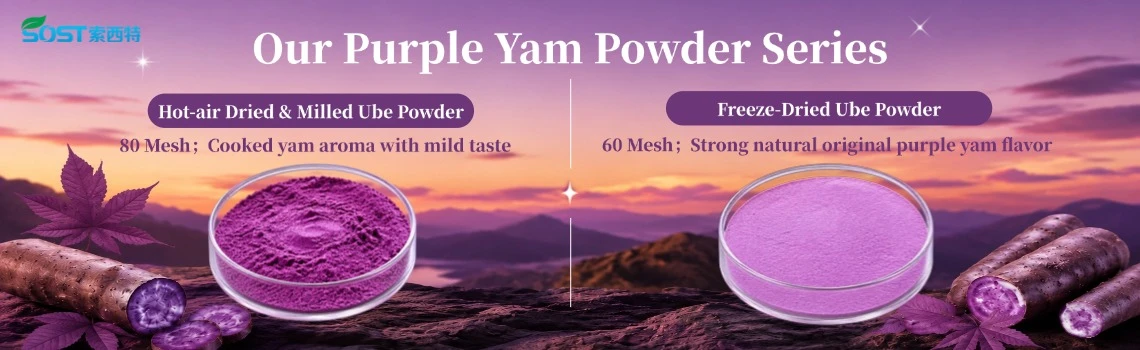
Spray-dried powder consists of fine, uniform particles; it possesses excellent flowability and allows for high-density packaging. It has a lighter purple hue; this is because high temperatures cause a degree of degradation in the natural pigments (anthocyanins) and trigger a mild browning reaction. In contrast, freeze-dried powder exhibits a deeper, more natural purple color. It has a light, airy texture-resembling a dry sponge-filled with countless tiny pores (voids). Regarding flavor, the high-heat treatment used during the spray-drying process imparts a rich aroma, reminiscent of roasted sweet potatoes. Freeze-dried powder, meanwhile, retains a flavor profile much closer to that of fresh UBE, as it preserves amino acids and vitamins that are typically heat-sensitive.
4. Storage and Transport Characteristics
This is a critical factor for international trade and long-term storage.
Because the particles of spray-dried powder are dense and solid, the product is highly resistant to moisture absorption. At room temperature, it is unlikely to clump or undergo color changes, making it well-suited for bulk transport and long-distance ocean freight.
Thanks to its porous structure, freeze-dried powder can be reconstituted into a smooth purée-indistinguishable from fresh UBE purée-within seconds of adding water. However, this same structure makes it extremely hygroscopic: even the slightest damage to the packaging will cause the powder to rapidly absorb moisture, leading to softening or clumping. Furthermore, the anthocyanins it contains are highly sensitive to light and heat; under such conditions, they degrade quickly, causing the vibrant purple color to shift toward a dark brown.
5. Which one should you choose?
These two types of powder are not in competition; rather, each serves its own unique purpose.
Spray-dried powder is more cost-effective to produce, making it ideal for large-scale manufacturing. Consequently, it is a common choice for a wide range of mass-market food products, such as instant beverages and baked goods.
Where to buy Ube Powder?
If you are sourcing Ube Powder (Purple Yam Powder, Dioscorea alata) and need a supplier who can back the clean-label claim with full batch COA, traceable source documentation, and third-party testing for anthocyanins, heavy metals and microbial limits, we are glad to help. Our team can provide the technical files you need for your regulatory review and answer any questions about specification, mesh size, documentation, or sampling. Feel free to reach out to us at info@sostherbusa.com, or visitour website www.sostherb.com to learn more about our Ube powder and request a quotation.
Send Inquiry